 InfluxDB: Introduction
Introduction to InfluxDB, everything you need to know about it
👋 Welcome to the Stackhero documentation!
Stackhero offers a ready-to-use InfluxDB cloud solution that provides a host of benefits, including:
- Unlimited writes, queries, dashboards, tasks, and buckets.
- Unlimited data retention time.
- Unlimited network and disk transfers.
- Effortless updates with just a click.
- Optimal performance and robust security powered by a private and dedicated VM.
Save time and simplify your life: it only takes 5 minutes to try Stackhero's InfluxDB cloud hosting solution!
What is InfluxDB
InfluxDB is an open-source time series database (TSDB) that excels in handling monitoring data, application metrics, Internet of Things (IoT) sensor readings, and real-time analytics. Developed primarily in Go, it is designed to deliver outstanding performance and efficient storage. InfluxDB can ingest thousands of data points each second, making it an excellent choice for industrial-grade applications.
Once your data is stored, you can query and analyze it using the Flux language. Flux is an integral component of InfluxDB that enables advanced data manipulation and offers deep insights into your metrics.
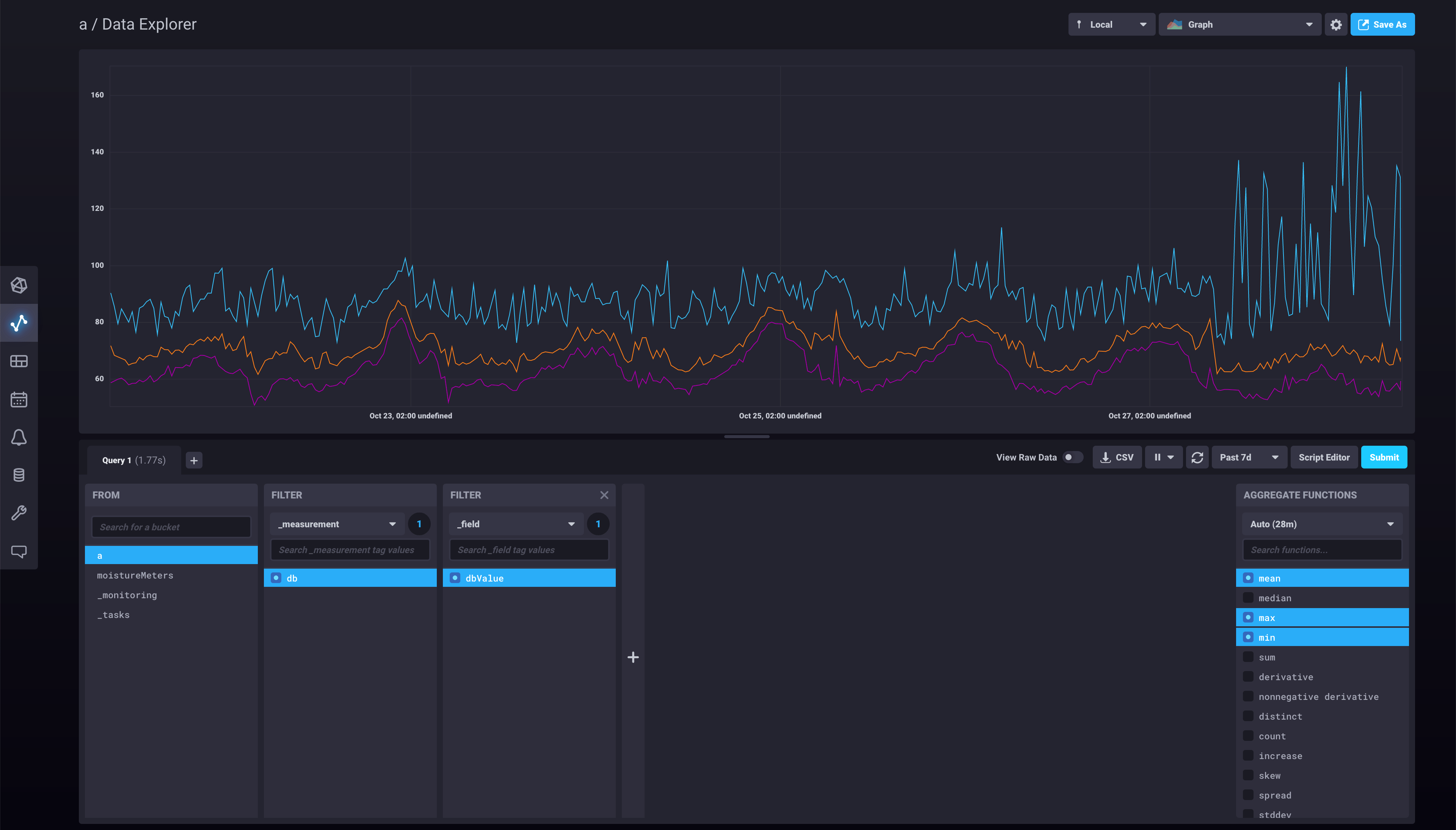 InfluxDB data exploration using its web UI
InfluxData, the company behind InfluxDB
InfluxDB was created in 2012 by InfluxData, originally known as Errplane. It received support from the Y Combinator startup accelerator, which has also backed companies such as Airbnb, Dropbox, PagerDuty, Coinbase, Stripe, and Twitch.
Over the years, InfluxData has earned the trust of many companies and investors while raising a total of $119 million since its inception. The company is headquartered in San Francisco, California, United States, although many team members work remotely from around the globe.
InfluxDB is a time series database (TSDB)
A time series database is optimized to store values that change over time. For instance, a temperature reading may update every minute. In InfluxDB, a key such as "temperature" is associated with a series of timestamps and corresponding values, making it highly efficient for storing real-time metrics. This focus on metric storage has established InfluxDB as one of the most recognized solutions in its category.
Differences between InfluxDB and relational databases
Time series databases differ from relational databases because they are designed to capture and query continuously updated metrics rather than structured relationships. Relational databases, such as MySQL or PostgreSQL, work well for storing structured data like user profiles and messages where data relationships are essential. In contrast, time series databases are built to efficiently record and analyze continuously updated measurements.
Differences between InfluxDB and NoSQL databases
NoSQL databases, such as MongoDB or OpenSearch, store data as documents that group multiple data points together. For example, a document might include a user's name, date of birth, and email address. Although these databases excel at document storage, they are not optimized for handling the high volume, time-dependent metrics that InfluxDB is engineered to manage.
When to use InfluxDB
InfluxDB is an excellent choice for storing, querying, and analyzing metrics data such as IoT sensor values, monitoring logs, and application performance metrics. Typically, IoT devices connected via WiFi, 5G, Sigfox, or LoRa send sensor readings at regular intervals. These readings may include temperature, 3-axis accelerometer data, or GPS coordinates and are often accompanied by system health information such as battery voltage and network reception. InfluxDB efficiently ingests these data points and, with its high-performance API, can handle thousands of inputs every second. The advanced Flux language makes it easy to query and analyze your data with just a few lines of code.
When not to use InfluxDB
If you need to store non-metric data, such as documents, user profiles, messages, or PDF files, InfluxDB might not be the best fit. In these cases, you might consider using databases like PostgreSQL, MySQL, or OpenSearch. Furthermore, if your primary goal is to monitor metrics for servers or network equipment such as switches and routers, a dedicated solution like Prometheus may be more suitable.
What makes InfluxDB so great
InfluxDB offers several compelling advantages:
- It efficiently handles telemetry data including monitoring logs, application metrics, and IoT sensor readings
- Data is automatically compressed to manage disk space effectively
- Automatic downsampling tasks help reduce disk usage and boost query performance
- Retention policies can be applied to automatically remove old data after a specified period
- The Flux language provides a powerful tool for in-depth data analysis
- The InfluxDB web UI lets you create visually appealing dashboards in minutes
What is InfluxDB cloud
InfluxDB cloud refers to a managed deployment of InfluxDB provided by a cloud provider rather than an on-premise setup. Several cloud providers offer InfluxDB instances and Stackhero is one of them. With Stackhero, you can access a dedicated InfluxDB instance in just 2 minutes, complete with out-of-the-box features such as:
- A private InfluxDB server
- Automatic backups every 24 hours
- Unlimited writes, queries, dashboards, tasks, and buckets
- Unlimited retention time
- Unlimited network and disk transfers
- TLS certificates (SSL/HTTPS) managed automatically
- The option to deploy in the United States or Europe
How to start InfluxDB
If you believe InfluxDB is the right solution for your project, you might consider trying a managed instance that is pre-configured and ready to use with just a single click. You can start a free demo instance in as little as 2 minutes and explore InfluxDB without any hassle. Once you are satisfied with your tests, upgrading to a production-ready instance is equally straightforward.
Click here to learn more about InfluxDB cloud and start it for free.